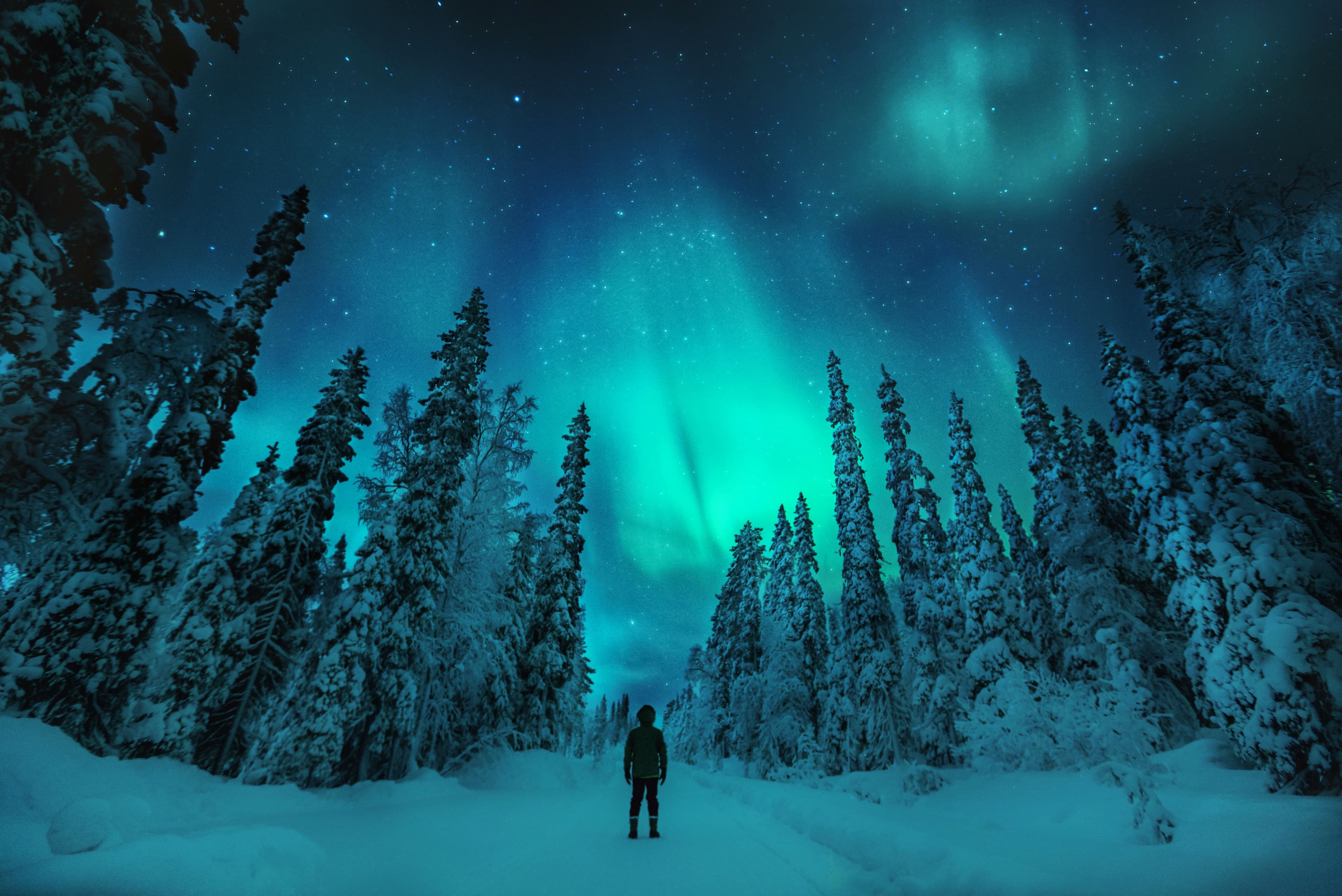
Northern lights · Ivalo, 68.6°N
Seeing the northern lights in Ivalo
We live under this sky and we still cannot promise it to you. What we can do is put you somewhere dark, on more than one night, with people who know where the cloud usually breaks. Here is exactly what that means — and what it cannot do.
- Where you would be standing
- Ivalo, Finnish Lapland — roughly 68.6°N, a little over two degrees of latitude north of the Arctic Circle.
- Season
- Roughly late August to early April. Outside that window the nights here are not dark enough to see anything.
- What usually decides your night
- Cloud — more often than the number on an aurora forecast.
- What we promise
- A method, and a straight answer about your dates. Never a sighting.
What 68.6 degrees north actually buys you
Latitude is the one part of this you buy simply by arriving.
The aurora is not scattered evenly over the night sky. It forms in a ring around the magnetic pole — the auroral oval — and northern Finland sits under the part of that ring where the lights are most often overhead rather than sitting low on the horizon.
That has a consequence people are surprised by. Further south you need a strong geomagnetic disturbance to push the oval down far enough to reach you, which is why aurora news is written in the language of storms and alerts. Here, you are already underneath it. A quiet night can still show you something.
It is also why this page gives you no number to watch. On a clear, dark night in Ivalo, modest activity is often enough; under an overcast sky, spectacular activity is worth nothing at all. The forecast that decides your evening is the cloud forecast, and almost nobody selling you a trip says so.
When to come
The lights are there all year. The darkness is not.
The season runs roughly from late August to early April, and the reason is the sun rather than the aurora. Around midsummer at this latitude the sun does not set. There is no night to look into, so there is nothing to see, whatever is happening above the daylight.
Late August and September. The lights come back before the snow does. The lakes are still open water, which means reflections, and it is not yet properly cold. Darkness arrives late in the evening at that time of year, so these are late nights rather than early ones.
Kaamos, the polar night. For a stretch of weeks around midwinter the sun does not clear the horizon here at all. That is not the black day people picture: there are hours of blue twilight in the middle of it, and it is the strangest and best light of the year. For aurora, what matters is that darkness starts in the afternoon — you can be standing under a dark sky at six in the evening instead of waiting up until two in the morning.
Late winter into early April. Daylight comes back quickly, and the dark still arrives early enough to be out under it after dinner. If you want full days as well as nights, this is where the compromise sits.
What actually decides your night
Cloud is a lid, and it does not care how good the aurora is.
The aurora happens far above the weather. Cloud sits underneath it. That is the entire relationship, and it explains both of the disappointments people report: a night the internet was excited about that was a complete blank from the ground, and an unremarkable forecast that turned into the best night of the trip.
So the order of questions is: is the sky clear anywhere we can reach tonight, and can we get you there. The geomagnetic forecast is the second question, never the first.
The moon matters less than people expect. A bright moon washes out the faintest displays, but it does not touch a strong one, and it lights the snow — which most people end up preferring once they see the photographs.
Why you have to leave the village behind
Ivalo is small. A village is still a village.
There are streetlights here, an airport, a lit forecourt at the petrol station. None of it is a city, but a faint arc that is obvious from a dark lake shore can be entirely invisible from a car park with a lamp on it. Getting away from that costs nothing and is the first thing worth doing.
Your own eyes are the other half of it. Vision adapts to darkness slowly and loses that adaptation instantly — one look at a phone screen and you begin again. On any given night the people who see the most are usually the ones who put the phone away and let their eyes settle.
How we give you the best chance
Not a guarantee — there is no honest one. A method, and you can hold us to each of these.
We get you away from the lights.
Darkness is the variable that costs nothing and is most often ignored. Out of the village, away from a lit yard, with a clear view of the northern sky and time for your eyes to adjust once you are there.
We read the cloud before the aurora forecast.
Both are worth watching, and we watch both. But only one of them is usually the reason you did or did not see anything, and it is not the one that makes the headlines.
We stay able to move.
Roads run north, south and east from Ivalo, and cloud is rarely uniform across a region this size. When the sky closes over one part of it, the answer is often to drive out from under it rather than to stand still and hope.
We plan for more than one night.
One night is one roll of the weather. Three nights is three, and that is the single biggest improvement available to you while you are still choosing dates — it costs nothing but time and it is entirely within your control. If you can only spare one night, come anyway; just do not build the whole trip on it.
We tell you when it is not worth going out.
A guide who says the cloud is solid everywhere within reach tonight, keep the evening for the sauna, is doing the job properly. Driving you around under an overcast sky so that it looks like we tried is not.
We tell you what it looks like before you arrive.
Which is the next section. It is the cheapest thing on this list and it prevents most of the disappointment we hear about.
What it actually looks like
The most preventable disappointment in Arctic travel.
A camera collects light for seconds at a time. Your eye does not. That one difference is why nearly every photograph you have seen of the northern lights is more saturated than what most people see on most nights — and neither the photograph nor your eye is lying about it.
A faint or moderate display often reads to the naked eye as a pale, greyish band. You might take it for a thin cloud, until you notice it is in the wrong part of the sky, or that it is moving in a way cloud does not move. Colour arrives as the display strengthens, green first.
The strong nights are entirely real. They move quickly, they fill the sky, and people here do see them. They are not every night, and anyone implying otherwise is selling something.
The part no photograph prepares you for is not the colour. It is the movement.
While you are waiting for the dark
In the depth of the season the sky does its work in the afternoon and evening. The rest of the day is a separate question.
Aurora is a night activity, and a trip built on nothing else is a trip spent waiting. What you do with the blue hours in between is worth deciding before you arrive rather than after.
- Experiences around IvaloThe aurora evenings themselves, and the other seven or eight kinds of day that fit around them. No dates on the page — tell us yours.
- Cabins, villas and chaletsWhere to sleep around Ivalo, Inari and Saariselkä, with live availability.
- A car of your ownBeing able to move when the cloud moves is most of the method on this page. Live rental prices from Ivalo airport.
- Where we actually areA street address in Ivalo, the office window in Finnish time, and the ways to reach a person.
Plan it with a person
Tell us when you can come, and we will tell you the truth about it.
Send your dates and we will say plainly what the darkness is doing then, how many nights we would give it, and what is worth doing in the hours in between. If the timing is wrong for the aurora, we will tell you that too — it is a shorter conversation and a better one.
We answer the same day. The office is open Monday to Friday, 09:00-17:00 EET. Nothing is charged, now or later on this site — we quote, you decide.
Rather write or call? [email protected] · +358 45 490 2090
No sighting on this page is guaranteed, because none can be. Everything else here — what there is to do, where to stay and the enquiry itself — is a real answer from real availability.